Article
How the brain makes the mind
And what goes wrong in illnesses of the mind
The mind is the working of the brain, just as circulation is the working of the heart. So to understand illnesses of the mind, we must look at how the brain does its work.
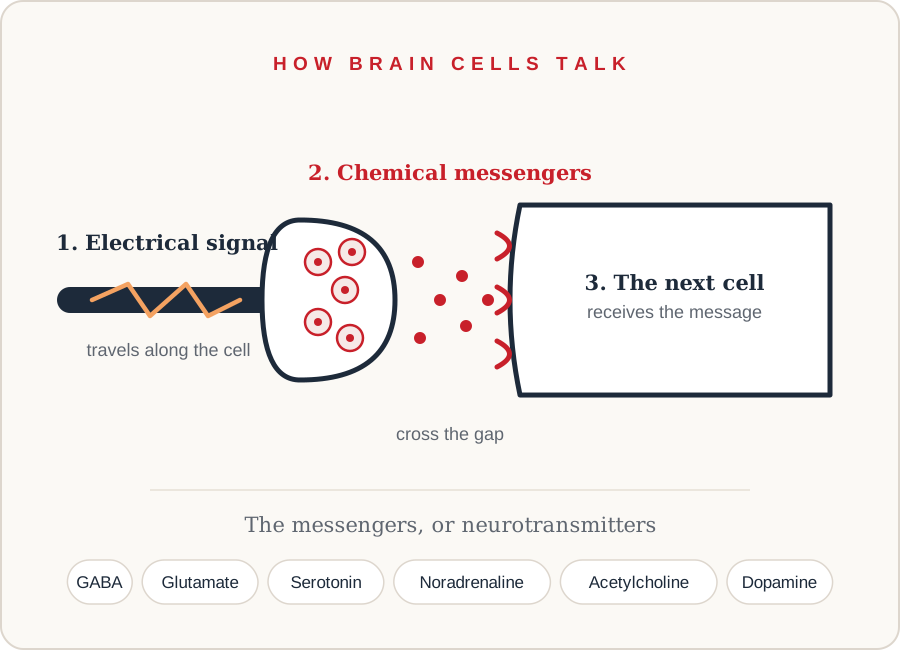
The brain has billions of cells called neurons. They work by passing messages to one another. The message travels in two forms. Inside a cell it is electrical. Between one cell and the next there is a tiny gap, and the message crosses it in chemical form.
When the electrical signal goes wrong
If a group of neurons fires suddenly and together, the result is a seizure. What the person experiences depends on the part of the brain involved. A seizure that begins in the temporal lobe, for example, can cause strange smells, sudden fear or a feeling of "I have been here before". Epilepsy is treated by neurologists, but it shows clearly that feelings and experiences arise from brain activity.
The chemical messengers
The chemicals that carry messages across the gap are called neurotransmitters. Think of them as the postmen of the brain. A few important ones:
- GABA and glutamate. The brake and the accelerator. One calms brain activity, the other drives it.
- Serotonin and noradrenaline. Involved in mood, anxiety, sleep and alertness.
- Acetylcholine. Important for memory and attention.
- Dopamine. Involved in reward, motivation and movement.
One example: dopamine
Too much dopamine activity in certain brain pathways is linked with psychosis, in which a person may hear voices or hold fixed false beliefs. Medicines for psychosis work by blocking dopamine receptors. Too little dopamine in another pathway causes the stiffness and tremor of Parkinson's disease. The same chemical, in different pathways, gives very different illnesses.
A word of caution. "Chemical imbalance" is a useful short form, not the whole truth. No blood test can measure the serotonin in your brain. Illnesses of the mind arise from brain circuits, genes, childhood, sleep, stress and life events acting together. That is why treatment often needs both medicine and talking therapy.
Illness of the mind is not a mystery, a weakness or a punishment. It is an organ, the brain, working under strain. And like other organs, it can be treated.