For doctors of all specialities
Mental health is not the absence of mental illness
The two-continua model, and why every physician needs it
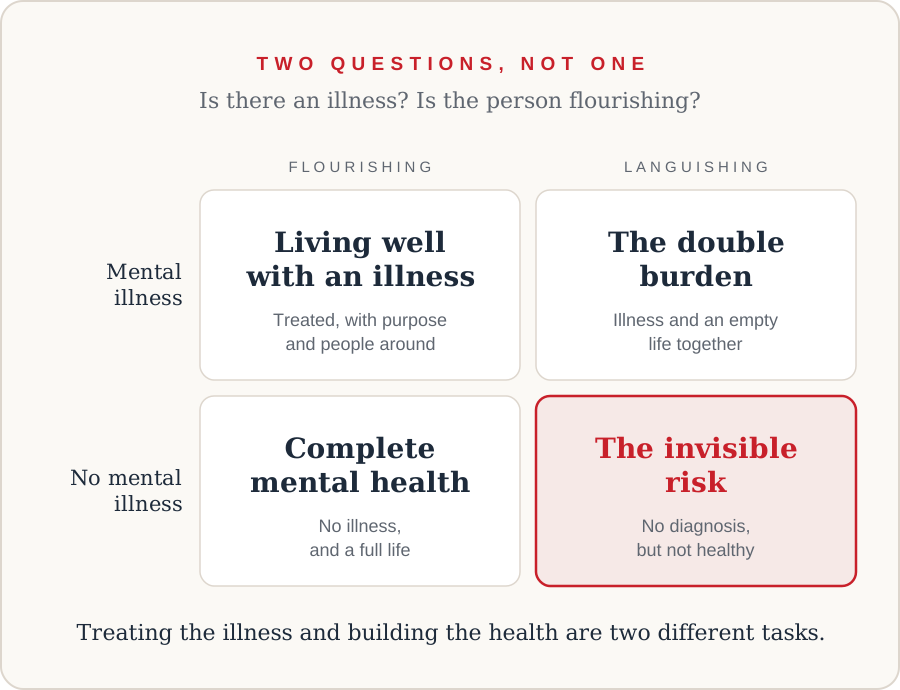
Consider two patients. The first is a 45-year-old engineer who has had bipolar disorder for ten years. He takes his medicines, sees his psychiatrist, exercises, has a good marriage and guides his juniors. His last episode was three years ago.
The second is a 42-year-old accountant with no psychiatric diagnosis. She passes every screening questionnaire. But her days feel empty, she has no close friend, she sleeps badly and drinks every evening. Asked how she is, she says, "Just surviving."
Who is mentally healthy? If you say the first, you have already rejected an old assumption: that health is only the absence of disease.
The evidence
The sociologist Corey Keyes tested this assumption on about 3,000 American adults in the MIDUS study. He compared two models. In one, illness and well-being were the two ends of a single line. In the other, they were two separate lines. The second model fitted the data better. The two were related (r = −0.53) but shared only about 28% of their variance. Knowing that a person has no illness tells you little about whether that person is doing well.
Keyes called high well-being flourishing and low well-being languishing. In his 2005 analysis, 18% of adults were flourishing, and 16.6% had "complete mental health", meaning flourishing with no mental disorder in the past year. So freedom from illness is common. Positive health is not.
Why it matters outside psychiatry
Languishing predicts illness. The same group was followed for ten years (1,723 adults). Gains in well-being predicted less mental illness later. Losses predicted more. A person without a diagnosis who is languishing is not "fine". He or she is at risk.
It may predict survival. Over ten years, adults who were not flourishing had higher odds of death from any cause, after adjusting for age, smoking, inactivity and physical illness (odds ratio 1.62; 95% CI 1.00 to 2.62). The interval touches 1, so treat this as a signal and not as proof.
Illness does not rule out health. In a Canadian national survey, 42% of adults with ADHD were in complete mental health, against 74% of those without ADHD. And among people who had a mood or anxiety disorder, those who were flourishing ten years later were far more likely to have recovered.
The diabetes comparison
Every physician already works with two lines in diabetes. One is disease control: HbA1c, drugs, screening for complications. The other is health: diet, exercise, weight, family support. A person with HbA1c of 6.5% who walks daily is ill and healthy. A sedentary, obese person with borderline sugars is not ill and not healthy.
Mental health works the same way. Medicines and psychotherapy control the illness. Purpose, relationships, sleep and activity build the health. Doing one does not automatically do the other.
In the consulting room
- Ask one more question. "Does your life feel meaningful these days?" or "Do you have people you feel close to?"
- Notice the invisible group. No diagnosis, but tired, lonely and without purpose. Many of them come with unexplained physical symptoms and repeated visits.
- Prescribe beyond tablets. Activity, sleep, social contact and meaningful work act on the second line.
- Measure it when useful. The Mental Health Continuum Short Form (MHC-SF) has 14 items and takes a few minutes.
The disease is the diagnosis. The health is the life. We have learnt to treat the first. It is time to attend to the second.
References
- Keyes CLM. Mental illness and/or mental health? Investigating axioms of the complete state model of health. J Consult Clin Psychol 2005;73:539–548.
- Keyes CLM, Dhingra SS, Simoes EJ. Change in level of positive mental health as a predictor of future risk of mental illness. Am J Public Health 2010;100:2366–2371.
- Keyes CLM, Simoes EJ. To flourish or not: positive mental health and all-cause mortality. Am J Public Health 2012;102:2164–2172.
- Iasiello M, van Agteren J, Keyes CLM, Muir-Cochrane E. Positive mental health as a predictor of recovery from mental illness. J Affect Disord 2019;251:227–230.
- Fuller-Thomson E, Ko BKD, Carrique L, MacNeil A. Flourishing despite ADHD. Int J Appl Posit Psychol 2022;7:431–461.