Article
"Am I mad?"
The suffering that nobody sees
A friend says gently, "Why don't you see a psychiatrist?" The reply comes at once: "Why? Am I mad?" That one question keeps a very large number of people away from treatment that would help them. To understand it, we must see that illnesses of the mind come in two forms.
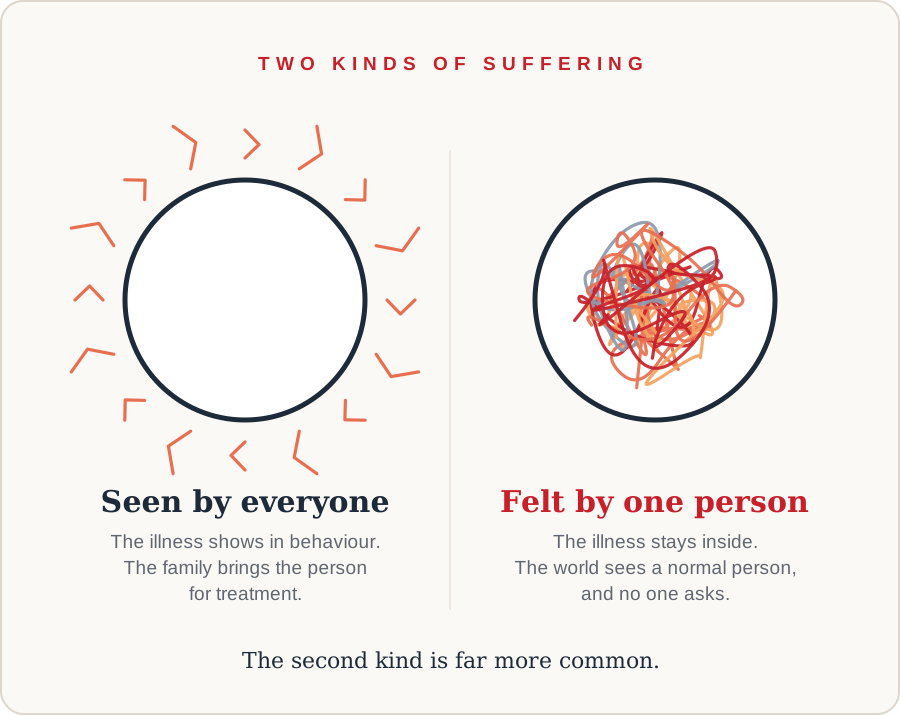
The illness that shows, and the illness that hides
In some illnesses, such as psychosis, the disturbance shows in behaviour. The person may talk or act in ways that others find strange. Society is quick to give cruel labels. Yet there is an irony here. Because everyone can see the problem, the family brings the person to a doctor, and treatment begins.
In most illnesses of the mind, nothing shows. Anxiety, depression, obsessions and stress-related bodily symptoms are fought entirely inside, in thoughts and feelings. The world sees a normal person going to work. The person suffers in silence. These conditions are far more common than psychosis, and far more often left untreated.
What was taught then, and what is known now
In the 1990s, medical textbooks gave a simple rule. If the patient knows that something is wrong with his mind, it is a neurosis. If he does not know, it is a psychosis. Neurosis was thought minor, and psychosis major.
We now know that the line is not so clean. Some people with schizophrenia understand their illness well. Many people with depression or anxiety do not recognise that they are ill; they blame their character, their fate or their stomach. Modern classifications have largely given up the word "neurosis". And "minor" was never a fair word. Minor to whom?
What silence costs
- Sleep, appetite and physical health.
- Work, studies and creativity.
- Marriage, friendships and the patience needed for children.
- Above all, inner peace.
Why people refuse help
The person compares himself with someone who has a visible illness and concludes, "I do not behave like that, so I do not need a psychiatrist." Behind this lies fear: the fear of being called a "mental patient". So the suffering continues for years, though it could be treated.
You do not have to be "mad" to seek help. You do not wait for a heart attack before checking your blood pressure. In the same way, you need not wait for a breakdown before caring for your mind.
Pain that is felt inside is as real as behaviour that is seen outside. Do not let the fear of a label take away your peace.